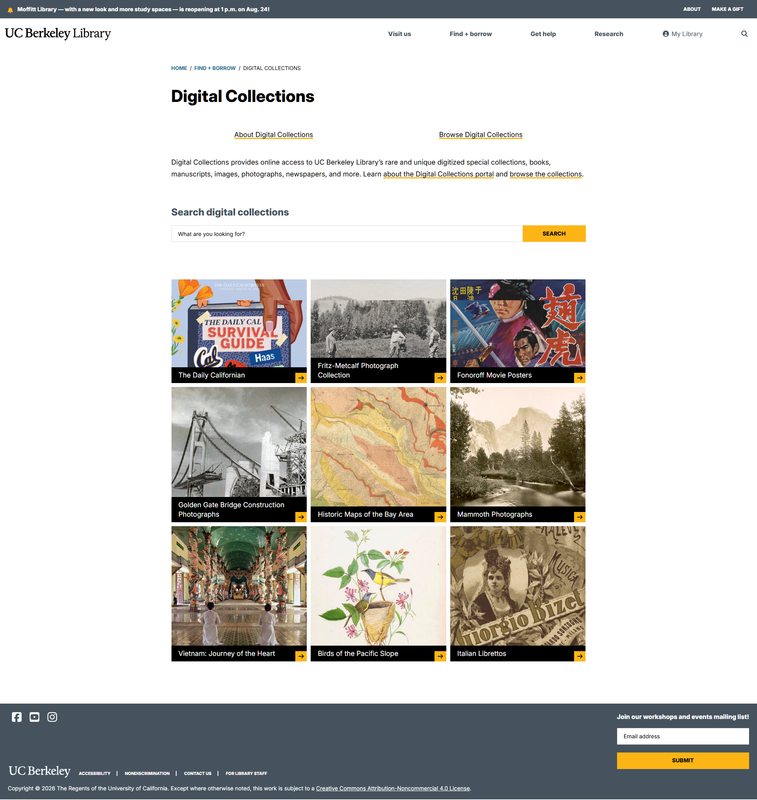


Digital Collections is your all-in-one portal into the UC Berkeley Library’s digital gems.
The digital materials you find here — images, text, audio, and video — enrich and support the work of Berkeley’s faculty, researchers, students, and staff. Digital Collections stems from the vision of the Digital Lifecycle Program, which serves the Library’s mission to preserve, protect, and provide access to the information it holds. This includes digital collections, archival records, and other materials that provide enduring value for intellectual inquiry, research, and discovery.
Our principles
(These principles and policies were developed in part with reference to and reliance on those of other academic libraries, memory institutions, and professional organizations, including University of Michigan, University of Illinois, the Society for American Archivists, American Library Association, and others.)
The Library encourages and supports research, teaching, and scholarship to advance global knowledge and understanding. By digitizing and sharing its treasures, both old and new, the Library can enhance research and scholarship across the world.
An imperative to enhance unfettered access to Library-digitized or acquired digital content guides our decisions related to digitization, discovery, and access. At the same time, the Library aspires to balance and inform such access to the digital historical record with legal, contractual, ethical, and safety considerations.
In providing digital access to materials and metadata from Library collections, the Library:
- Adheres to copyright law, including the transfer or license of copyrighted materials to or by the university, and supports the exercise of fair use and the dissemination of materials in the public domain;
- Respects people’s statutory and common law rights to privacy and individuals’ publicity rights, and adheres to applicable legal requirements in protecting those rights;
- Adheres to provisions in agreements we have entered into regarding materials in our collections; and
- Accounts for social and religious customs, and other circumstances (including documented evidence of a clear and imminent threat of personal or legal harm, or risks of exploitation of people, natural or cultural resources, or indigenous knowledge) that may impact use of some materials in our collections.
The Library, at its own discretion, may restrict access to or use of digital reproductions and update metadata according to each of these principles. We further acknowledge the historical and evolving social, cultural, and political contexts in which the materials under our current stewardship have been created, collected, and used. We approach access decisions in relation to those contexts and in consultation with communities of origin where appropriate.
Given our commitment to preserving the authenticity and integrity of the scholarly and historical record, we are unable to correct errors or inaccuracies present in original items. Requests for takedowns, access restrictions, or metadata updating will be considered only in keeping with recognized legal rights and the principles above.