
Welcome to the National Museum of Asian Art!
Established a century ago, the National Museum of Asian Art was the Smithsonian’s first art museum. Committed to preserving, exhibiting, researching, and interpreting art in ways that deepen our collective understanding of Asia and the world, the museum stewards one of North America’s largest and most comprehensive collections of Asian art.
Its rich holdings bring the arts of Asia into direct dialogue with an important collection of nineteenth- and early twentieth-century American works, providing an essential platform for creative collaboration and cultural exchange between the United States, Asia, and the Middle East.
Beginning with a 1906 gift that paved the way for the museum’s opening in 1923, the National Museum of Asian Art is a leading resource for visitors, students, and scholars in the United States and internationally. Its galleries, laboratories, archives, and library are located on the National Mall in Washington, DC, and are part of the world’s largest museum complex, which typically reports more than 27 million visits each year. The museum is free and open to the public 364 days a year, making its exhibitions, programs, learning opportunities, and digital initiatives accessible to global audiences.
When you visit our galleries or delve into the stories of our collections online, we hope you find a portal to different ways of interpreting our world. We invite you to learn and explore in your own way—to look deeply into the past to better understand the present and to break through the artificial barriers that can separate us.
Our Collections
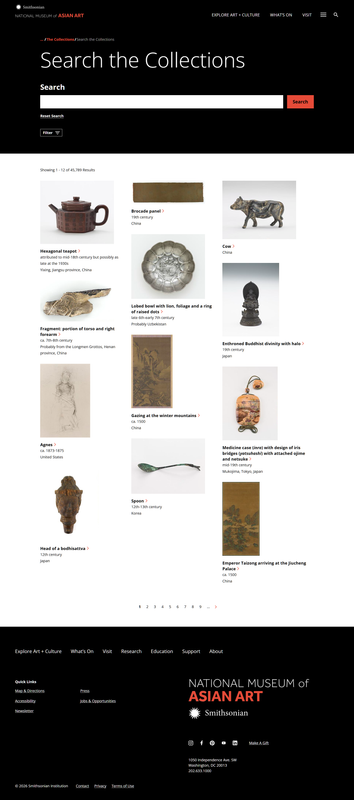
We hold in trust for the American public more than 46,000 objects dating from antiquity to the present from China, Japan, Korea, South Asia, Southeast Asia, and the Middle East as well as an important collection of nineteenth- and early twentieth-century American works from the Aesthetic Movement. New acquisitions are constantly added, and the museum now showcases the richness of premodern Asian arts and the evolving visual cultures of Asia in the twentieth and twenty-first centuries. Utilizing our world-class library and archives, visitors can explore nearly every region and historic period of Asia and the Islamic world, and scholars will find value in our exemplary objects as springboards for research.