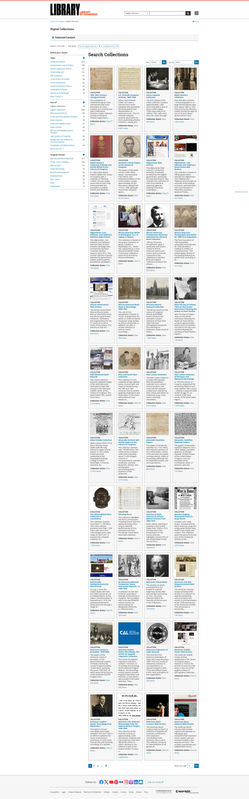

大都会艺术博物馆 数字馆藏
大都会艺术博物馆收藏。通过 49 万多件艺术作品,环游世界,穿越 5000 年的历史。


The Library of Congress is the largest library in the world, with millions of books, films and video, audio recordings, photographs, newspapers, maps and manuscripts in its collections. The Library is the main research arm of the U.S. Congress and the home of the U.S. Copyright Office.
The Library preserves and provides access to a rich, diverse and enduring source of knowledge to inform, inspire and engage you in your intellectual and creative endeavors. Whether you are new to the Library of Congress or an experienced researcher, we have a world-class staff ready to assist you online and in person.
We encourage you to visit the Library of Congress in person in Washington, D.C., explore the Library online from wherever you are and connect with us on social media.
View the Library of Congress FY2024-FY2028 Strategic Plan
Download the FY2024-FY-2028 Strategic Plan (PDF 71 MB)
An agency of the legislative branch of the U.S. government, the Library of Congress encompasses several integral service units, listed below.
The Office of the Librarian is the administrative branch of the Library of Congress and has overall management responsibility for the Library. It sets policy and directs and supports programs and activities to accomplish the Library’s mission.
CRS exclusively serves Congress by providing confidential, objective and authoritative research and analysis to help inform the legislative debate.
The U.S. Copyright Office administers the Nation’s copyright laws for the advancement of the public good, offers services and support to authors and users of creative works, and provides expert impartial assistance to Congress, the courts and executive branch agencies on questions of copyright law and policy.
The Library Collections & Services Group serves the Library’s universal collections, which document the history and further the creativity of the American people and which record and contribute to the advancement of civilization and knowledge throughout the world. The group’s work includes acquiring, organizing, providing access to, maintaining, securing, and preserving these collections.
The Library Collections and Services Group includes the following divisions:

This introductory essay and the timeline that follows are based on entries in America’s Greatest Library: An Illustrated History of the Library of Congress by Library of Congress Historian John Y. Cole, with a Foreword by Librarian of Congress Carla D. Hayden. The volume was published in late 2017 by the Library of Congress in association with D Giles Limited, London.
Books and libraries were essential to America’s founding generation. Most of the founders received vigorous classical educations. It follows, then, that most of the members of the new U.S. Congress, which met first in New York City and then in Philadelphia, were also avid readers. In both cities, Congress had access to sizable libraries: the New York Society Library and the Free Library of Philadelphia.
In 1800, as part of an act of Congress providing for the removal of the new national government from Philadelphia to Washington, President John Adams approved an act of Congress providing $5,000 for books for the use of Congress—the beginning of the Library of Congress. A Joint Congressional Committee—the first joint committee—would furnish oversight. In 1802, President Thomas Jefferson approved a legislative compromise that made the job of Librarian of Congress a presidential appointment, giving the Library of Congress a unique relationship with the American Presidency. Jefferson named the first two Librarians of Congress, each of whom also served as the clerk of the House of Representatives.
It was also former President Jefferson, retired to Monticello, who came to the new Library’s rescue during the War of 1812. In 1814, the British burned Washington, destroying the Capitol and the small congressional library in its north wing. Congress accepted Jefferson’s offer to sell his comprehensive personal library of 6,487 books to “recommence” its own library. Jefferson’s concept of universality is the rationale for the comprehensive collecting policies of today’s Library of Congress.
Furthermore, Jefferson’s belief in the power of knowledge and the direct link between knowledge and democracy has shaped the Library’s philosophy of sharing its rich, often unique collections and services, as widely as possible.
From today’s perspective, it is obvious that the Library plays important legislative, national, and international roles. However, it was not clear during the Library’s early decades in the U.S. Capitol that it would evolve into more than a legislative institution, a role favored by the Joint Library Committee. Moreover, it was plagued by fire, space shortages, understaffing and the lack of an annual appropriation. Although it made popular literature available to the general public, the Library’s primary purpose was to serve Congress.
The situation changed dramatically after the Civil War as the country settled down, the economy expanded, and both the federal government and the city of Washington grew rapidly.
Ainsworth Rand Spofford (Librarian of Congress 1864-1897) took full advantage of an emerging cultural nationalism to persuade the Congress to view its Library as a national institution and therefore the national library.
In the spirit of Jefferson, Spofford successfully advocated a single, comprehensive collection of American publications for use by both Congress and the American people. The centralization of U.S. copyright registration and deposit at the Library of Congress in 1870 was essential for the annual growth of these collections.
Spofford’s greatest challenge was to persuade Congress to construct a much-needed separate Library building. The process began with an architectural competition in 1873 and consumed his interest and activities until the massive building opened to Congressional and public acclaim in 1897. The impressive new structure in Italian Renaissance style, the largest library in the world when it opened in 1897, was a monument to American achievement and ambition. It was named for Thomas Jefferson in 1980.
The 20th century would see that magnificent building welcome increased staff, diverse multimedia collections and a steady stream of new patrons. Most of this progress was shaped by Herbert Putnam, who was appointed Librarian of Congress in 1899, as the country entered the Progressive Era.
An experienced librarian, Putnam came to the post with a comprehensive plan for the Library of Congress as a national library. President Theodore Roosevelt agreed with Putnam’s basic premise, which the Librarian summarized in a 1901 speech to the American Library Association: the new “National Library” should “reach out” to support other libraries throughout the nation. In the early 1900s, the president agreed with Putnam’s steadily increasing requests for additional funds, and so did Congress. Moreover, in 1903 Roosevelt issued an executive order that transferred the records of the Continental Congress and the personal papers of six of the founding fathers to the Library to be “preserved and made more accessible.”
In 1914, Putnam established the Legislative Reference Service (LRS) as a separate Library department. This effort was supported by Wisconsin Sen. Robert M. LaFollette Sr., who felt that Congress thus had “taken an important step in rendering the business of lawmaking more exact, economically sound and scientific.”
With President Roosevelt’s endorsement, a vote of confidence through an increased annual budget from Congress and the space provided by an attractive new annex building (today known as the John Adams Building), Putnam pursued his plan with what others described as “energetic nationalism.” The result, between 1901 and 1928, was a series of new national library services, research publications, and catalogs, cultural functions and new offices.
The Library’s symbolic role as a repository and promoter of the democratic tradition was of special appeal to Putnam’s successor, Archibald MacLeish, who served as Librarian of Congress during most of World War II. MacLeish relished the Library’s role as the custodian of the Declaration of Independence and the U.S. Constitution and helped plan the shipment of the documents, along with other treasures, to Fort Knox, Kentucky, and additional sites for safekeeping during the war.
Having weathered two world wars, expanded its collections and constructed a second building, the Library of Congress approached the 1960s on firm footing. Challenges lay ahead, however, for a new global era of growth was underway. In response, the Library gradually took on a new international role. Hallmarks of the period were a continuation of post-World War II interest in international affairs (especially in relations with Soviet Union, Africa and Asia), accelerated technological change in all walks of life, and increased funding for libraries and research materials in the United States and abroad. A new national concern for civil rights was prompted in part by racial violence and the assassinations of President John F. Kennedy, Sen. Robert F. Kennedy, and Rev. Martin Luther King Jr.
The introduction of automation into the Library’s cataloging procedures and the initial development of the Library’s overseas acquisitions and cataloging programs contributed strongly to the institution’s unprecedented rate of growth between 1954 and 1975. In those 21 years presided over by Librarian of Congress L. Quincy Mumford, the Library’s book collection increased from 10 to 17 million volumes, the staff from 1,600 to 4,500 and the annual appropriation from $9.5 million to $116 million. In collaboration with Congress and the Office of the Architect of the Capitol, in 1958 the Library initiated planning for a third major building on Capitol Hill.
Librarian Mumford was well aware of the need to “balance” the legislative and national responsibilities of the Library, both which grew dramatically during his tenure. In 1962, in response to critics who suggested that the needs of the nation’s research libraries might be better served if the Library of Congress was moved from the legislative to the executive branch of government, he strongly defended the institution’s legislative branch location. He also asserted that “the Library of Congress today performs more national library functions than any other national library in the world.”
Historian Daniel J. Boorstin was appointed Librarian of Congress in 1975 by President Gerald R. Ford. Greater public visibility for the institution was one of his primary objectives. Several of the offices he created, including the American Folklife Center, the Center for the Book and the Council of Scholars, were public-private partnerships assisted by advisory boards and private funding. In 1980, he presided over the opening of the James Madison Memorial Building. In 1984 he obtained a major appropriation for the multi-year restoration and modernization of the Jefferson and Adams Buildings.
Key activities expanding the Library’s functions at all levels benefited from the leadership of Librarian of Congress James H. Billington in the 1990s and the first decade of the 21st century. These included the development of a National Digital Library, the John W. Kluge Center for Scholars, and the opening of the National Audio-Visual Center on the Library’s new Packard Campus in Culpeper, Virginia.
In 2016, President Barack Obama nominated librarian Carla Hayden, chief executive officer of the Enoch Pratt Free Library in Baltimore, Maryland, to be the 14th Librarian of Congress. The first woman and African-American to serve as Librarian, she inherited a unique, global institution, widely known for its free, non-partisan service to Congress, librarians, scholars, and the public—in the United States and around the world.
本站安逸导航提供的美国国会图书馆 数字馆藏都来源于网络,不保证外部链接的准确性和完整性,同时,对于该外部链接的指向,不由安逸导航实际控制,在08/15/2026 09:15收录时,该网页上的内容,都属于合规合法,后期网页的内容如出现违规,可以直接联系网站管理员进行删除,安逸导航不承担任何责任。