

加州大学伯克利分校图书馆 数字馆藏
The UC Berkeley Library helps current and future users find, evaluate, use and create knowledge to better the world. 数字馆藏提供在线访问加州大学伯克利分校图书馆珍稀独特的数字化特藏、书籍、手稿、图像、照片、报纸等资源。了解数字馆藏门户网站并浏览馆藏。


(英语:Patricia Buckley Ebrey, 1947-)是美国历史学家,汉学家,主要研究中国宋朝文化和性别因素。伊佩霞是她的中文名。伊佩霞1968年获得芝加哥大学学士学位,1970年和1975年在哥伦比亚大学分别获得硕士和博士学位。博士毕业后随即被任命为伊利诺伊大学厄巴纳-香槟分校访问助理教授,1982年成为助理教授,三年后成为东亚研究及历史学的正教授。她现在是在华盛顿大学担任教授。著作《剑桥插图中国史》(1996年)《剑桥插图中国史》第二版(2010年)《宋徽宗传》(2013年)。
Funding for this project was provided by the Education Division of the National Endowment for the Humanities, an independent federal agency, the Freeman Foundation, and the Chiang Ching- Kuo Foundation. The project also received technical assistance from the University of Washington’s Center for Advanced Research Technology in the Arts and Humanities.
|
A Visual Sourcebook of Chinese Civilization Prepared by Patricia Buckley Ebrey |
||
|
With the assistance of |
|
|
|
|
|
|
|
||
| The project was made possible by financial support from the Education Division of the National Endowment for the Humanities, an independent federal agency, the Freeman Foundation, and the Chiang Ching- Kuo Foundation. | ||
| This site is best viewed using Internet Explorer 4 or higher on an IBM compatible computer with a screen resolution of 1024 by 768. Alignment of images and text is sometimes irregular with other browsers and computers. | ||

| The goal of this “visual sourcebook” is to add to the material teachers can use to help their students understand Chinese history, culture, and society. It was not designed to stand alone; we assume that teachers who use it will also assign a textbook with basic information about Chinese history.
Several pedagogical concerns shaped the design of this website. Although some topics (e.g. philosophy, religion, social distinctions, historiography) are best taught through written texts, many facets of Chinese civilization are more easily conveyed through images (material culture, technology, visual and performing arts, and so on). We have therefore not attempted to illustrate all the major themes of a course on China. Moreover, rather than give a few pictures of many topics, as illustrated histories often do, we have instead prepared substantial units on ten important subject areas spanning the length of Chinese history: geography, archaeology, religion, calligraphy, military technology, painting, homes, gardens, clothing, and the graphic arts. Students should be able to view these units before coming to class, much as they would read texts in a sourcebook of primary sources . This out-of-class preparation can provide the basis for classroom discussion, on-line discussion, or written assignments. To facilitate such discussion and analysis, we have included questions designed to make students think about the images they are viewing. To help keep the chronology and geography straight, we have included many maps and a timeline. |
A Visual Sourcebook for Chinese Civilization
|
Period Topic CONTENTS |
|||||||||||||||||||
|
|
|
||||||||||||||||||

|
||||||
| 2500 BC |  Neolithic China Neolithic China




|
|||||
| . | Neolithic tomb at Dawenkou | |||||
| 2000 BC | ||||||
| . | ||||||
| 1500 BC | Shang ca 1600-
1000 |
|||||
| . | Shang tomb of Fu Hao | |||||
| 1000 BC | ||||||
| . | Zhou
ca 1000- 256 BC |
Zhou tomb of Count Yu | ||||
| 500 BC | ||||||
| . | Warring States tomb of Marquis Yi | |||||
| 200 BC | ||||||
| . | Han
206 BC- AD 220 |
|||||
| 100 BC | ||||||
| . | Han tomb of Liu Sheng | |||||
| 0 | ||||||
| . | ||||||
| 100 AD | ||||||
| . | ||||||
| 200 | ||||||
| . | Period of
Division 220-581 |
|||||
| 300 | ||||||
| . | Famous calligraphers | |||||
| 400 | ||||||
| . | Buddhist cave temples | |||||
| 500 | Buddhist sculpture and painting | |||||
| . | ||||||
| 600 | Sui | |||||
| . | Tang
618-906 |
|||||
| 700 | Buddhist images | |||||
| . | ||||||
| 800 | Famous calligraphers | |||||
| . | ||||||
| 900 | ||||||
| . | 5 Dynasties | |||||
| 1000 | Song
960-1276 |
Military technology | ||||
| . | ||||||
| 1100 | Paintings | |||||
| . | ||||||
| 1200 | ||||||
| . | ||||||
| 1300 | Yuan | Paintings | ||||
| . | ||||||
| 1400 | Ming
1368-1644 |
|||||
| . | Hardwood furniture | |||||
| 1500 | ||||||
| . | Elegant gardens | |||||
| 1600 | ||||||
| . | Qing
1644-1911 |
|||||
| 1700 | Clothing | |||||
| . | ||||||
| 1800 | ||||||
| . | ||||||
| 1900 | ||||||
| . | Clothing | |||||
| 1925 | Advertising | |||||
| . | Woodcuts | |||||
| 1950 | PRC | Buddhist worship | ||||
| . | Ordinary homes | |||||
| 1975 | Political posters | |||||
| . | Fayuan temple | |||||
| 2000 | Minorities | |||||
| Modern Calligraphy | ||||||
| More Maps: Click to see maps of contemporary China’s twenty-two provinces, five autonomous regions, four municipalities, and two special administrative regions.
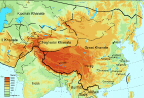
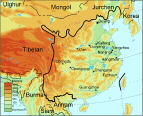
The historical maps and the maps of China’s provinces (any maps without sources given) were all specially made for this site. The base contour map was created by tracing the map of China on p. 56 of the 1968 Britannica World Atlas. Province boundaries and approximate historical boundaries were drawn freehand by consulting other reference works, such as the Zhongguo lishi ditu ji series. No attempt has been made to take into account the changes in the coastline over the centuries, as all the maps are made from the same base map. |

|
Teachers who tested this website in their classes suggested that the most useful form of teachers’ guide would be a printable version of the site, which would allow them to plan classes more conveniently. To make printing easier, we placed all of the sources, hints, answers, and further thoughts on the same page as the images and questions and removed the background images. We also added a brief introduction to each unit, identifying its objectives and discussing strategies for teaching it. These files, listed below, are in Adobe’s pdf format; downloading pdf files requires Adobe Acrobat Reader. As mentioned in the Purpose, the design of this website assumes that students also have access to other information about Chinese history and culture, such as a textbook. Students with inadequate background may be frustrated by some of the questions, which we wrote to try to get students to pause to look closely at the images and think about them. In a minority of cases we have supplied answers or hints, but we did not want to offer answers to all questions, in large part because we feared that students would get in the habit of immediately hitting the answer button as soon as they had read a question. Many of the questions with no answers or hints ask students’ their opinions on the images and therefore do not have a single correct answer. In other cases, the material needed to answer the question is found elsewhere on the page. Teachers who are venturing into material they have never taught before may therefore want to consult general introductions to Chinese art or history to be better able to help students with some of the more open-ended questions. Some recent works that can be recommended are Craig Clunas, Art in China (1997), Patricia Ebrey, Cambridge Illustrated History of China (1996), Robert Murowchick, Cradles of Civilization: China (1994), Edward Shaughnessy, China: Empire and Civilization (2000), Conrad Schirokauer, A Brief History of Chinese Civilization (1991), Michael Sullivan, The Arts of China (2000), and Robert Thorp and Richard Vinograd, Chinese Art and Culture (2001).
Pdf files for individual units: Teachers’ Guide for Ancient Tombs Teachers’ Guide for Calligraphy |

It is generally easiest to navigate this site from Contents or the Timeline, but there may be times when it is useful to consult a list of the main pages, which is given here. This list does not include the hundreds of pages that give source citations, nor the pages that extend the text by giving answers, thoughts, further comments, or enlarged details. It also does not list the separate pages of the Teachers’ Guide or the Timeline and Maps.
Front Matter
F1 Purpose
F2 Contents
F4 Sitemap
Units
1.1 Land
1.11 China Proper
1.111 The Great Wall
1.112 Yellow River
1.113 Yangtze River
1.12 Outer China
1.2 People
2.21 Bronzes from Fu Hao’s Tomb
2.211 Piece-Mold Techniques
2.31 Bronzes from Count Yu’s Tomb
2.32 Jades from Count Yu’s Tomb
2.4 Warring States Tomb of Marquis Yi
2.41 Inscriptions
2.43 Musical Instruments
2.431 Restoration of the Bells
2.44 Bronzes from Marquis Yi’s Tomb
2.45 Lacquer Objects
2.46 Gold and Silver
2.51 Diagram of Tomb
2.52 Bronze Objects
2.53 Jade Objects
3 Buddhism
3.1 Images
3.11 Buddhas
3.12 Bodhisattvas
3.13 Other Divinities
3.14 Groups of Images
3.2 Temples
3.21 Cave Temples
3.22 Urban Temples
3.3 Practice
3.31 Monks and Nuns
3.32 Lay People
4.1 Script Types
4.2 Techniques of Transmission
4.4 Tang Calligraphy
4.21 Early Tang Court Calligraphy
4.22 Other Script Types
4.23 Religious Writings
4.24 Individualist Styles
4.5 Calligraphy in Modern China
5.1 Siegecraft
5.2 Crossbows
5.3 Spears and Clubs
5.4 Catapults
5.5 Warships
6 Painting
6.1 Painting as a Social Record
6.11 Urban Life
6.111 Shops and Commerce
6.112 Means of Transportation
6.113 Individuals on the Street
6.12 Private Life
6.121 The Private Realm of the Literati
6.1211 The Night Revels of Minister Han Xizai
6.21 Landscape Painting
6.211 Northern Song Landscape Painting
6.2111 Guo Xi’s Early Spring
6.212 Southern Song Landscape Painting
6.213 Yuan Landscape Painting
6.22 Court Painting
6.221 Paintings with Political Agendas
6.222 Bird and Flower Painting
6.23 Scholar Painting
6.231 Figures and Animals
6.232 Bamboo, Plum, and Other Plants
7 Homes
7.11 Fengshui
7.12 Earth as a Building Material
7.13 Roof Tiles
7.14 Wooden Framing
7.15 Regional Variation
7.151 Cave Dwellings
7.16 Decorative Elements
7.2 Interiors
7.21 Kang
7.22 Beds
7.23 Furniture
8 Gardens
8.2 Garden Design
8.21 Rocks and Mountains
8.22 Water
8.23 Buildings
8.24 Plants
8.241 Paving Patterns
8.3 The Garden as a Site for Social Activity
8.5 Garden of the Master of Nets
9 Clothing
9.12 Evidence from Photographs
9.121 Men
9.122 Women
9.13 Making Cloth
9.131 Sericulture
9.21 Adaptations to Western Styles
9.211 Qipao
9.212 Mao Suits
9.213 Western-Style Suits
9.23 Weddings
10 Graphic Arts
10. 1 Commercial Advertisements
10.11Calendar Posters
10.111 Folk Calendars
10.12 Magazine Advertisements
10.13 Book Covers
10.2 Political Propaganda
10.21 Woodcuts
10.22 PRC under Mao
10.221 Leaders and Role Models
10.222 Science and Technology
10.223 Youth and Education
10.224 Cultural Revolution
10.3 Contemporary Graphic Arts
10.31 Four Modernizations Era
10.32 Contemporary Advertising